The Construction View: Recording a Request with ClojureStorm
The inspector chapter answered one question precisely: where did this element come from? Hold a key, hover a badge, and your editor opens the exact .clj line that produced it. That is a map from a pixel to a source location: a static fact, welded onto the Hiccup at read time.
This chapter and the next answer a different question, the one you actually ask when something looks wrong: how was this whole page built, and where did this value come from? Not “what line is this <td>,” but “which functions ran, which Datomic queries fired, at what basis-t, and which of them produced the stale title I’m staring at.” It is a recording of one request’s execution, tied back to the DOM the request produced.
The inspector is the spatial half: element to code. This is the temporal half: element to the code-and-data that ran. The two share exactly one thing, and it is the thing that makes the second half cheap: the welded coordinate. The inspector stamps data-myapp-name="myapp.web.views/recipe-card" on every component root. If our execution trace records frames keyed by the same "ns/fn" string, then a clicked element and the function call that rendered it are joined by a plain attribute selector: no new index, no fuzzy matching. We reuse the format, not the mechanism.
It is worth being concrete about the payoff before the machinery, because the machinery is the bulk of this chapter. Picture the bug these two chapters exist to kill: a recipe card on the index shows a title you are sure is wrong. The browser shows you the wrong pixels and nothing else. With the construction view, you Alt+click that card and the tool answers in layers. This is the third recipe-card call. Here is the exact pull that fed it, the d/q that listed it, and the basis-t they read at. And here is the entity id to hand to d/history when the read trace comes back green and the real culprit was a write three days ago. That is the end state. Everything below is how a recording becomes able to answer that, and it is involved, so keep that one gesture in mind as the thing all of it is for.
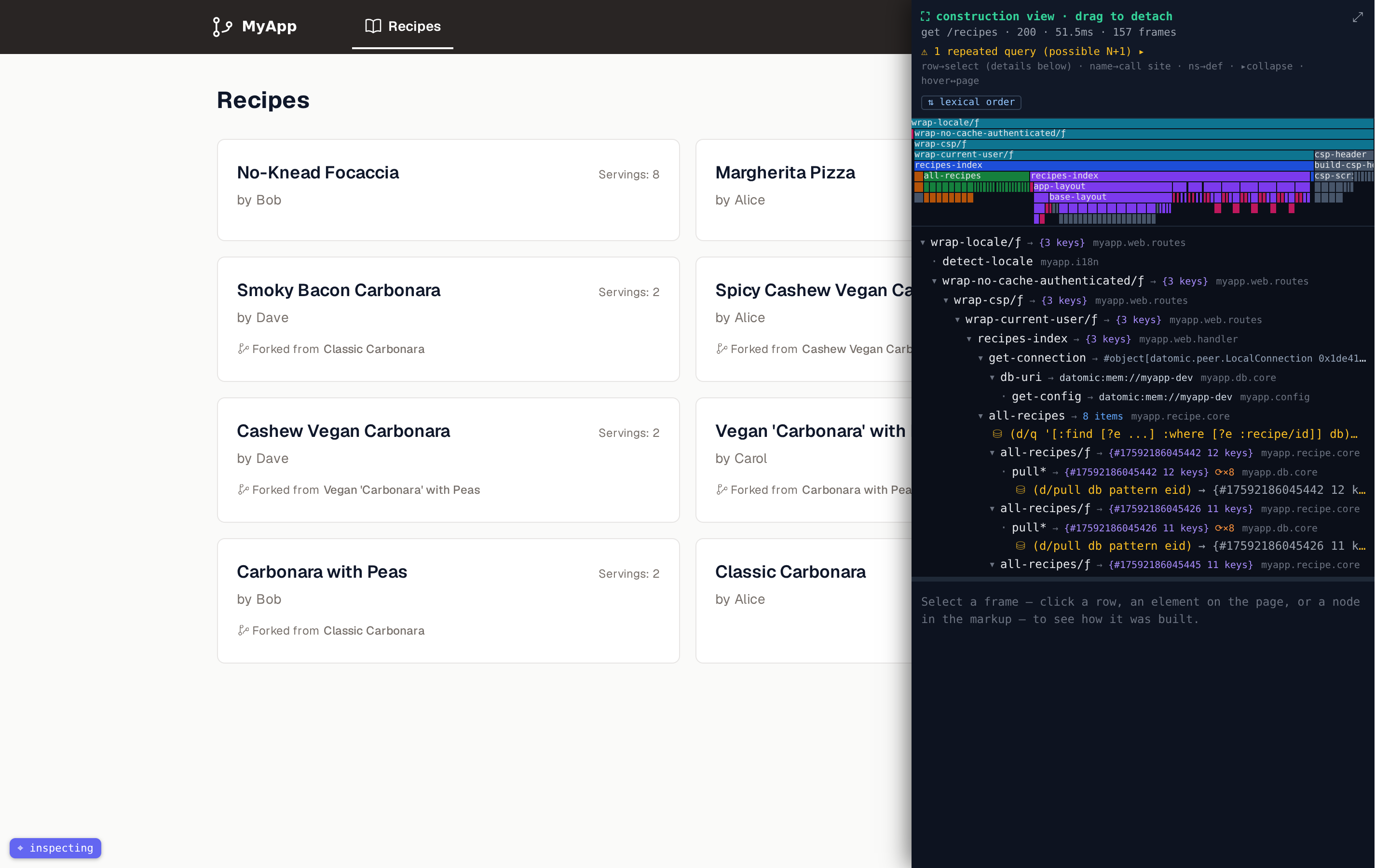
The end state this chapter builds toward: one request’s full execution (157 frames, every Datomic read, a repeated-query signal) recorded and projected into a navigable call tree.
The feature is large enough to build in two movements. This chapter records a request and projects it into a call tree (middleware to handler to domain to view, with every Datomic read) served as JSON. The next chapter adds the targeted projections over the same recording, flow (trace one element’s value back to the query behind it) and a dossier of drill-downs, and builds the in-page overlay that renders all of it. Everything is dev-only and structurally absent from production, the same standard the rest of our dev infrastructure holds itself to; it reuses the inspector’s welded coordinates, the /dev/ws editor relay from the live-reload chapter, and the defn-asset dev block from the Hiccup views chapter. The whole server lives in one dev-only namespace, dev/trace.clj, which we build from the bottom up here.
Why not just extend the inspector?
The obvious move is to generalize what we already have. The inspector auto-instruments every view function by wrapping its var:
;; myapp.web.inspector — the existing pattern
(alter-var-root v (constantly
  (with-meta (fn [& args] (tag-hiccup (apply orig args) src nm)) {::orig orig})))
Replace tag-hiccup with “open a span / run / close a span,” thread a dynamic *current-span*, and you have a hand-rolled tracer. It works. For a while. Then you notice what it can’t see. alter-var-root wraps vars. Anonymous functions, the bodies of map/reduce/for, a tight numeric loop – none of those are vars, so none of them are spans. You get an accurate tree of named-function edges and nothing inside them. For “which queries built this page,” that happens to be enough, because the edges that do the work are all named domain functions. For “trace this value back through the code,” it is not: the value was shaped by a (:user/display-name (:recipe/user recipe)) buried in a view, and a var-wrapper never sees that expression at all.
You could push harder – instrument more, propagate context across threads, capture argument values without pinning them – but at that point you are rebuilding an omniscient debugger by hand. Someone already built one, at the compiler level, and it sees every sub-expression.
Decision – adopt the recording, build the correlation. The right division of labor is: let ClojureStorm record the execution (it is unbeatable at that, and goes deeper than any var-wrapping we’d write); keep the correlation to the rendered DOM ours, because nobody else has our welded coordinate. We adopt the engine and build the part that is genuinely new. The seam between the two is one string:
"ns/fn".
ClojureStorm as a dev-only compiler
FlowStorm is a time-travel debugger for Clojure. Its companion, ClojureStorm, is a drop-in build of the Clojure compiler that emits instrumentation into every namespace it compiles, recording each sub-expression’s value as your program runs. You opt in by swapping the compiler, which sounds drastic until you realize it is the dev/prod split we already use everywhere else: a :dev-only dependency. Here is the whole alias in deps.edn:
;; ClojureStorm: a DEV-ONLY compiler swap that records execution for the
;; construction-view tracer. It replaces org.clojure/clojure with FlowStorm's
;; drop-in compiler build, which emits instrumentation into every myapp.*
;; namespace it compiles. Combine with the dev alias: clojure -M:dev:storm:repl
:storm {:classpath-overrides {org.clojure/clojure nil}        ; drop vanilla Clojure
        :extra-deps {com.github.flow-storm/clojure {:mvn/version "1.12.5-1"}
                     com.github.flow-storm/flow-storm-dbg {:mvn/version "4.6.0"}}
        :jvm-opts ["-Dclojure.storm.instrumentEnable=true"
                   "-Dclojure.storm.instrumentOnlyPrefixes=myapp."   ; our code only
                   "-Dclojure.storm.instrumentAutoPrefixes=false"
                   ;; NOTE: no flowstorm.startRecording=true — recording is OFF at
                   ;; boot and driven per-page by the tracer (see below).
                   "-Xmx2g"                                          ; loud OOM if the leak ever returns
                   "-Dmyapp.dev=true"]}
:classpath-overrides {org.clojure/clojure nil} drops the normal Clojure jar so ClojureStorm’s build provides clojure.core; instrumentOnlyPrefixes=myapp. keeps the recording to our functions (instrumenting clojure.core would bury the signal under millions of frames). Production never sees any of this: it resolves org.clojure/clojure, sets no storm properties, records nothing. The compiler swap is the heaviest dev affordance in the book (it slows startup and makes the first hit to a page noticeably slower), which is why it lives behind an alias you choose to type.
Notice what is not in that list: flowstorm.startRecording=true. The obvious move is to record from boot and read whatever’s there, and it is the move we made first. It is also the move we backed out of, because it is a memory leak. ClojureStorm’s per-thread timelines are append-only; with recording left on, every view-namespace load, every REPL eval, every background tick accretes entries that are never reclaimed, and over a days-long :storm session the recording grew to roughly 30 GB. So recording is off at boot, and the tracer turns it on for exactly the span of one page render and off again; the recorder only ever holds the page currently on screen. The -Xmx2g cap is the backstop: if that leak ever creeps back, it surfaces as a fast, loud OutOfMemoryError instead of silently eating host RAM for a day. (The per-render gating and the evict-on-navigation rule are both part of the middleware below; how the overlay reads a visit’s accumulated recordings, the page plus the morphs since, is chapter 18’s business.)
When the dev system starts under :storm, hot-reload calls the tracer’s setup! through the debugger API, guarded on the same storm property so a plain :dev REPL never tries to load FlowStorm:
;; dev/hot_reload.clj — in the dev system startup
(when (System/getProperty "clojure.storm.instrumentEnable")
  (try
    (when-let [setup (requiring-resolve 'trace/setup!)] (setup))
    (log/info "Construction-view tracer enabled (ClojureStorm)")
    (catch Throwable e (log/warn e "Trace setup failed"))))
That resolves to setup! in trace.clj, which, perhaps surprisingly, turns recording off. Recording is gated per page, so the steady state at boot is “not recording”; the page-render path is the only thing that flips it on:
(defn enable-recording!  [] (try (dbg/set-recording true)  (catch Throwable _ nil)))
(defn disable-recording! [] (try (dbg/set-recording false) (catch Throwable _ nil)))

(defn setup! []
  ;; Start NOT recording. A page request turns recording on for the duration of
  ;; its own render and off again (see record-page), so boot-time view loading,
  ;; DB seeding, REPL evals, and idle time accrete nothing.
  (disable-recording!))
Why a compiler and not a Java agent or OpenTelemetry? A Java agent (Byte Buddy, AspectJ) is the same idea, less Clojure-aware – dominated. OpenTelemetry is the industrial answer and the right tool when you want spans to leave the process into Jaeger or Tempo; but its spans are coarse (HTTP, JDBC, manual boundaries) and exported elsewhere, neither of which serves an in-page view at expression granularity. We are building a debugger affordance, not an observability pipeline. The two are answers to different questions, and conflating them gets you the worst of both.
The trace namespace itself instruments nothing; its whole job is to read FlowStorm’s recordings and project them into JSON:
(ns trace
  "DEV-ONLY: the runtime half of the inspector — a per-request construction view
  plus a flow drill-down, read from a ClojureStorm execution recording."
  (:require
    [clojure.string :as str]
    [clojure.set :as set]
    [datomic.api :as d]
    [flow-storm.runtime.indexes.api :as ia]
    [flow-storm.runtime.debuggers-api :as dbg]
    [myapp.web.inspector :as inspector]
    [jsonista.core :as json]))
The rest of the chapter builds this namespace from the bottom up.
Reading the recording
ClojureStorm keeps one timeline per JVM thread: an append-only sequence of entries. We never call the debugger UI; we read the timeline directly through flow-storm.runtime.indexes.api. Four entry shapes matter, and as-immutable turns each into a plain map:
{:type :fn-call   :fn-ns "myapp.recipe.core" :fn-name "recipe-by-id"
 :form-id 8829    :fn-args [<db> #uuid"…"] :parent-idx 41 :ret-idx 58}
{:type :expr      :coord [4 1] :result #{17592186045442 …} :fn-call-idx 42}
{:type :fn-return :result {…} :fn-call-idx 42}
{:type :fn-unwind :coord [3 2] :throwable <ex> :fn-call-idx 42}     ; a frame that threw
Five facts, stacked, are everything we need:
- A
:fn-call’s own index in the timeline is its identity. Children point back to it via:parent-idx(other calls) and:fn-call-idx(the expressions inside it). So the call tree falls straight out of:parent-idx: no separate tree to assemble. :fn-nsand:fn-nameare strings, so(str fn-ns "/" fn-name)is"myapp.web.views/recipe-card", byte-identical to thedata-myapp-namethe inspector already stamps on the DOM. That string is the join key, and it costs us nothing.:fn-argsand:resultcarry the real recorded values. A query frame’s first argument is the Datomic db, so its basis-t is one(d/basis-t …)away. We never copy or pin these: they live in FlowStorm’s recorder; we only read them when asked.- An expression’s
:coordplus the enclosing form’s:form-idresolve, viaget-form-at-coord, to the source sub-form as data, line metadata included. A:coordis a path of indices into the nested form:[4 1]names the sub-form at index 1 inside the sub-form at index 4 of the enclosing top-level form. That fact is what makes the data-flow half possible. - A
:fn-unwindmarks a frame the stack unwound through because an exception propagated; its:coordpins the throwing expression. That is how we surface a 500 later.
A couple of one-liners get us oriented on the current thread:
(defn- thread-id ^long [] (.threadId (Thread/currentThread)))
(defn- timeline-len [tid] (if-let [tl (ia/get-timeline tid)] (count tl) 0))
Reading one request is reading a slice of one thread’s timeline. We realize the slice once, aligned back to absolute indices, and index the fn-calls by their identity. This read-window is the workhorse every projection starts from, in this chapter and the next:
(defn- read-window [tid start end]
  (let [tl (ia/get-timeline tid)
        total (if tl (count tl) 0)
        end (min end total)
        slice (if (and tl (< start end))
                (into [] (comp (drop start) (take (- end start)) (map ia/as-immutable)) tl)
                [])
        calls (persistent!
                (reduce (fn [acc [j m]] (if (= :fn-call (:type m)) (assoc! acc (+ start j) m) acc))
                  (transient {}) (map-indexed vector slice)))
        ;; exprs keep their absolute timeline idx so call-site recovery can pick the
        ;; parent expr that fires right after a (possibly wrapped) child returns.
        exprs-by-call (->> slice
                           (map-indexed (fn [j m] (when (= :expr (:type m)) (assoc m :idx (+ start j)))))
                           (remove nil?)
                           (group-by :fn-call-idx))
        ;; thrown frames: tagged with idx so the innermost (origin) is the lowest-idx unwind.
        unwinds (->> slice
                     (map-indexed (fn [j m] (when (= :fn-unwind (:type m)) (assoc m :idx (+ start j)))))
                     (remove nil?))]
    {:calls calls
     :exprs-by-call exprs-by-call
     :unwinds unwinds
     :at (fn [abs] (let [j (- abs start)] (when (and (>= j 0) (< j (count slice))) (nth slice j))))}))
The shape it returns is the vocabulary for everything that follows: :calls maps an absolute timeline index → the :fn-call map; :exprs-by-call groups every recorded expression under the frame it ran in; :unwinds is the (usually empty) list of thrown frames; and :at looks up any absolute index (we use it to fetch a frame’s :fn-return result by its :ret-idx).
Per-request scoping, and the gift of a synchronous handler
Where do start and end come from? A Ring middleware, placed outermost, records the thread’s timeline length before and after the handler. This is the one piece on the request hot path, so it does as little as possible. It does not build the tree; it stores a small descriptor (the thread id and window bounds, plus the request’s own metadata) and returns:
(defn- record-page [handler req]
  (when (full-navigation? req) (clear-recordings!)) ; a full navigation evicts the prior visit
  (enable-recording!)                               ; ...then record ONLY for this render
  (let [tid (thread-id) start (timeline-len tid) t0 (System/nanoTime)]
    (try
      (let [resp (handler req) ms (/ (- (System/nanoTime) t0) 1e6)]
        (if (html? resp)
          (let [id (str (java.util.UUID/randomUUID))]
            (put! id {:id id :tid tid :start start :end (timeline-len tid) :epoch @epoch
                      :uri (:uri req) :method (:request-method req) :status (:status resp) :ms ms})
            (-> resp (assoc-in [:headers "X-Myapp-Trace"] id) (update :body stamp-html id)))
          resp))
      (catch Throwable e
        ;; the handler threw — store the (errored) window so it's inspectable, then
        ;; re-throw so the app's own error handling is unchanged.
        (let [id (str (java.util.UUID/randomUUID)) ms (/ (- (System/nanoTime) t0) 1e6)]
          (put! id {:id id :tid tid :start start :end (timeline-len tid) :epoch @epoch
                    :uri (:uri req) :method (:request-method req) :status 500 :ms ms :errored true})
          (reset! last-error {:id id :uri (:uri req) :ex (.getName (class e))})
          (throw e)))
      ;; ...and off again the moment it returns, so the recorder is idle between requests
      (finally (disable-recording!)))))

(defn wrap-trace [handler]
  (fn [req]
    (if (and (not (str/starts-with? (str (:uri req)) "/dev/"))
             (page-request? req))
      (record-page handler req)   ; the only path that records
      (handler req))))            ; assets, JSON XHR, /dev/ fetches: recording stays off
Four helpers it leans on. The first decides whether a request is even worth recording. Only a page render is, never a sub-resource or a prefetch:
(defn- page-request? [req]
  (let [h (:headers req)]
    (and (#{:get :post} (:request-method req))
         (some-> (get h "accept") (str/includes? "text/html"))
         (not (some-> (get h "sec-purpose") (str/includes? "prefetch")))
         (not (some-> (get h "purpose")     (str/includes? "prefetch"))))))
This is the same Accept: text/html distinction the dispatcher already trades on: a full navigation, a form submit, and the dispatcher’s fetch-and-morph all ask for text/html, while CSS/JS/image sub-resources and JSON XHR do not. Gating on it means the recorder is never even switched on for an asset, an XHR, or a prefetch, so assets and idle time accrete nothing, and a recorded window is always a page the user actually saw.
One caveat is owed here. The dispatcher chapter called this header vestigial and warned against building server logic on it; page-request? is the deliberate exception, and it does not break the rule’s reason. The warning protects the application’s responses: a handler that branches on Accept couples what it renders to how it was called, and the no-JavaScript path stays correct only while the server stays oblivious. page-request? renders nothing. It toggles a dev-only recorder in a namespace production never loads, and a wrong guess costs a recording, not a response.
The second decides when a recording’s lease is up. A full navigation (address bar, hard refresh, back/forward, a plain form submit) replaces everything on screen, so the previous visit and all the morphs layered onto it go stale together, and record-page evicts them before recording the new page. An in-page morph swaps only a region; the rest of the page and its trace ids are still on screen and must stay readable, so a morph records but never clears. The browser has already made this distinction for us:
(defn- full-navigation? [req]
  ;; Browsers tag top-level loads `Sec-Fetch-Mode: navigate`; the dispatcher's
  ;; fetch-and-morph is a fetch(), so its mode is cors/same-origin — NOT
  ;; navigate. (Non-browser clients omit the header; treat them as full loads
  ;; so a bare curl still resets.)
  (let [mode (get-in req [:headers "sec-fetch-mode"])]
    (or (nil? mode) (= mode "navigate"))))
This is the eviction rule the memory story below leans on, and one more place the platform hands us a distinction we would otherwise have to invent. The other two helpers recognize an HTML response, and weld the trace id onto its <html> so the browser can find it:
(defn- html? [resp]
  (some-> (get-in resp [:headers "Content-Type"]) (str/includes? "text/html")))

(defn- stamp-html [body id]
  (if (string? body)
    (str/replace-first body "<html" (str "<html data-myapp-trace-id=\"" id "\""))
    body))
This is sound for one reason, and it is the same reason the inspector’s for-row tagging was sound: our request path is synchronous. http-kit serves each request start-to-finish on one worker thread; every handler calls the domain layer and Datomic inline; hiccup2’s html macro forces its sequences eagerly before the response map is returned. So a request is exactly the slice [start, end) of one thread’s timeline: no future, no core.async, no context-propagation machinery to chase a span across threads. (An async handler would break this; the day one appears, the slice boundary is the thing to revisit.)
A request is a slice: record-page flips recording on, notes the timeline length before and after the handler, and stores a small descriptor. Everything heavy stays where it already lives.
We also stamp X-Myapp-Trace on every HTML response, morph replies included. That header is what lets the overlay re-attach a trace to a region the dispatcher morphs in later; the next chapter’s cross-region traces collect on it.
Decision – project lazily, off the hot path. An early version built the whole tree inside
wrap-trace, which taxed every page and, worse, copied recorded values into our own store (pinning large pulled maps and skewing the very memory numbers the admin dashboard reports). Storing a{:tid :start :end}descriptor and projecting on fetch fixes both: the request pays almost nothing, the heavy values stay in FlowStorm’s recorder where they belong, and the expensive form-level analysis below becomes affordable, because it only runs for traces a human actually opens.
The descriptors live in a small bounded ring buffer (newest-wins, capped), keyed by the request id. An epoch counter lets clear-recordings! invalidate everything at once:
(defonce ^:private epoch (atom 0))
(defonce ^:private store (atom {:order clojure.lang.PersistentQueue/EMPTY :by-id {}}))
(defonce ^:private last-error (atom nil))    ; most recent uncaught-error trace

(def ^:private cap 256)

(defn- put! [id desc]
  (swap! store
    (fn [{:keys [order by-id]}]
      (let [order (conj order id) by-id (assoc by-id id desc)]
        (if (> (count order) cap)
          {:order (pop order) :by-id (dissoc by-id (peek order))}
          {:order order :by-id by-id})))))

;; a descriptor is valid only within its epoch — a clear bumps the epoch, so every
;; older id silently expires (its window may no longer exist in the recorder).
(defn- get-desc [id] (let [d (get-in @store [:by-id id])] (when (and d (= (:epoch d) @epoch)) d)))

(defn clear-recordings! []
  (try
    (swap! epoch inc)
    (dbg/clear-flows)
    (reset! store {:order clojure.lang.PersistentQueue/EMPTY :by-id {}})
    (reset! last-error nil)
    (catch Throwable _ nil)))
What bounds memory – two caps, on two different things. The timeline’s cap is the gating you have already seen: recording is on only for the span of a render, and a full navigation evicts the previous visit, so the recorder holds at most the current visit (the page plus any morphs layered onto it since). The ring buffer is a second, independent cap on a much smaller thing: the compact
{:tid :start :end …}descriptors, of which we keep the newest 256. Theclear-recordings!handle and its/dev/__trace-clearendpoint remain as an escape hatch, not a discipline you have to remember.
Everything else in trace.clj is a projection: a pure function from a stored descriptor to JSON. They all start the same way: resolve the descriptor, read-window its slice, build something, serialize. The top-level one is project, which we assemble piece by piece over the next sections; here is the endpoint wrapper that serializes it:
(defn get-trace-json
  "Build + serialize the Trace for /dev/__trace/:id (nil if id unknown/expired)."
  [id]
  (when-let [d (get-desc id)]
    (try (json/write-value-as-string (project d))
         (catch Throwable e (json/write-value-as-string {:id id :error (str (.getMessage e))})))))
Summarizing values without forcing them
Every projection emits ValueRefs: small JSON maps describing a recorded value without shipping the value itself. This matters for three reasons: the values can be huge (a pulled recipe map), lazy (an unrealized seq we must not force), or unprintable (a Datomic db). summarize is the one function that turns any recorded value into a safe descriptor the eye can take in at a glance, and it is careful about all three:
(defn- db? [v] (try (instance? datomic.Database v) (catch Throwable _ false)))
(defn- safe-eid [v] (try (:db/id v) (catch Throwable _ nil)))  ; sorted-map compares can throw

(defn summarize [v]
  (try
    (cond
      (nil? v) {:kind "nil"}
      (db? v) {:kind "db" :type "datomic.Database" :basis-t (try (d/basis-t v) (catch Throwable _ nil))}
      (string? v) {:kind "scalar" :type "String" :preview (trunc v 80)}
      (number? v) {:kind "scalar" :type (tname v) :preview (str v)}
      (boolean? v) {:kind "scalar" :type "Boolean" :preview (str v)}
      (keyword? v) {:kind "scalar" :type "Keyword" :preview (str v)}
      (instance? java.util.UUID v) {:kind "scalar" :type "UUID" :preview (str v)}
      ;; a Hiccup element (vector with an HTML-tag head) — label it <tag>, not [n=N]
      (inspector/element? v) {:kind "hiccup" :tag (first (str/split (name (first v)) #"[.#]")) :n (count v)}
      (map? v) (let [eid (safe-eid v)]
                 (cond-> {:kind "map" :type (tname v) :n (count v)
                          :keys (mapv str (take 12 (keys v)))
                          :preview (trunc (bounded-pr v) 120)}
                   eid (assoc :eid eid)))
      (counted? v) {:kind "coll" :type (tname v) :n (count v) :preview (trunc (bounded-pr v) 120)}
      (seq? v) {:kind "seq" :type (tname v)}        ; lazy / uncounted — NEVER (count) it
      :else {:kind "opaque" :type (tname v) :preview (trunc (bounded-pr v) 80)})
    (catch Throwable _ {:kind "opaque" :type (try (tname v) (catch Throwable _ "?"))})))
A db becomes {:kind "db" :basis-t …}, never (count)ed or printed. A counted? collection reports its size, but a bare seq? is labeled (lazy) without realizing it (forcing a recorded lazy seq could run side effects or blow up). And safe-eid notices when a map is a Datomic entity (:db/id present), stamping :eid, the hook the flow drill-down will match on next chapter. Everything is wrapped in try because we are summarizing arbitrary recorded values, some of which throw on count/print/compare.
The bounded printer and a Datalog-friendly form printer round out the helpers:
(defn- tname ^String [v] (.getName (class v)))
(defn- trunc [s n] (let [s (str s)] (if (> (count s) n) (str (subs s 0 n) "…") s)))
(defn- bounded-pr [v]
  (binding [*print-level* 3 *print-length* 8] (try (pr-str v) (catch Throwable _ "?"))))

(defn- form->str
  "pr-str a source form but render (quote x) as 'x so datalog reads cleanly."
  [x]
  (try
    (cond
      (and (seq? x) (= 'quote (first x))) (str "'" (form->str (second x)))
      (seq? x) (str "(" (str/join " " (map form->str x)) ")")
      (vector? x) (str "[" (str/join " " (map form->str x)) "]")
      :else (pr-str x))
    (catch Throwable _ (pr-str x))))
form->str is a small thing that matters a lot for readability: it renders (quote [:find ?e …]) as '[:find ?e …], so the queries we surface read exactly as written in the source rather than as (quote …) noise.
Frame naming and noise filtering
ClojureStorm records everything under myapp.*, including the inspector’s own wrapper frames, for-loop machinery (iter--…), and pure date-shuffling helpers. None of those belong in a construction view. Two predicates draw the line. short-name turns a raw ns/fn into a label, collapsing anonymous/iter/eval fns to owner/ƒ:
(defn- short-name [^String nm]
  (let [segs (str/split nm #"/") lst (peek segs)]
    (if (and (> (count segs) 1) (re-find #"^(fn|iter|eval)[-_]" lst))
      (str (nth segs (- (count segs) 2)) "/ƒ")
      lst)))

(def ^:private plumbing-fns #{"convert-dates" "convert-instants" "as-instant"})

(defn- noise? [m]
  (let [ns-str (:fn-ns m) nm (str (:fn-name m))]
    (or (= ns-str "myapp.web.inspector")          ; our own instrument-var wrappers
        (str/includes? nm "iter--")               ; for/lazy-seq body machinery
        (contains? plumbing-fns nm)               ; pure date plumbing — not "construction"
        (some #(str/starts-with? nm (str % "/")) plumbing-fns))))
noise? is consulted everywhere a frame might appear, so the inspector’s instrumentation never shows up inside the view of the page it instrumented, a small but important bit of hygiene, since both features are live at once.
DB ops from expressions, not from names
Here is the part where reading expressions, not just function calls, pays off, and where the naive design fails in an instructive way.
The tempting way to surface “what did this page query” is to flag the database wrapper functions: pull*, q*, transact* in myapp.db.core. List their names, badge any frame whose name is on the list. It is a five-line predicate, and it is wrong, because half our reads never go through the wrappers. recipe/core calls d/q, d/history, d/as-of, and d/entid directly, and those are not even functions we compiled, so ClojureStorm records no :fn-call for them at all. A name-allowlist is structurally blind to the time-travel reads a recipe-versioning app is built around.
But a raw (d/q '[...] db) is still an expression inside an instrumented function, and ClojureStorm recorded it. Its :coord and the enclosing function’s :form-id hand us the sub-form as data. So we detect a Datomic call by shape, scan the recorded expressions in db-relevant namespaces, and resolve each back to its source sub-form:
(def ^:private db-nss
  #{"myapp.recipe.core" "myapp.db.core" "myapp.auth.core" "myapp.admin.core"
    "myapp.analytics.db" "myapp.web.handler"})

(def ^:private datomic-ops
  #{"q" "pull" "pull-many" "entid" "as-of" "history" "transact" "datoms" "entity"})

(defn- datomic-call? [sf]
  (and (seq? sf) (symbol? (first sf))
       (#{"d" "datomic.api"} (namespace (first sf)))
       (contains? datomic-ops (name (first sf)))))

(defn- collect-db-exprs
  "All Datomic-call exprs in the window (under db-relevant fns), as
  {:call-idx i :sf <sub-form> :e <expr-entry>}."
  [{:keys [calls exprs-by-call]}]
  (->> (for [[i es] exprs-by-call
             :let [m (calls i)]
             :when (and m (contains? db-nss (:fn-ns m)))
             e es
             :let [sf (try (ia/get-form-at-coord (:form-id m) (:coord e)) (catch Throwable _ nil))]
             :when (datomic-call? sf)]
         {:call-idx i :sf sf :e e})
       (sort-by :call-idx)))
This unifies the two cases instead of special-casing them. The d/pull inside pull* and the raw d/q in all-recipes are both just d/* expressions; each becomes a db-op attached to the function it ran in. And because we have the sub-form, we have the real Datalog as data: the query itself.
The basis-t is the other half of a useful db-op. We want the t the read actually saw, and for a time-travel read that is not the live basis-t. db-t extracts the meaningful point of a db value, and nearest-db-basis walks up the call tree to find the db a frame was handed:
(defn- db-t
  "The meaningful t of a db value: its as-of POINT when it's a time-travel db
  (d/as-of-t — note d/basis-t of an as-of db is still the LIVE basis-t, since
  as-of filters but doesn't lower basis), else its basis-t."
  [db]
  (or (try (d/as-of-t db) (catch Throwable _ nil))
      (try (d/basis-t db) (catch Throwable _ nil))))

(defn- nearest-db-basis
  "The t of the nearest in-scope db ARG: this fn-call's db arg, else an ancestor's."
  [calls i]
  (loop [k i]
    (when-let [m (calls k)]
      (if-let [db (first (filter db? (:fn-args m)))]
        (db-t db)
        (recur (:parent-idx m))))))

(defn- ->db-op [calls {:keys [call-idx sf e]}]
  (let [op (name (first sf))
        bt (if (and (#{"as-of" "history"} op) (db? (:result e)))
             (db-t (:result e))                    ; the time-travel db's own point
             (nearest-db-basis calls call-idx))]
    {:op op
     :form (trunc (form->str sf) 600)   ; full enough to read the whole datalog in the detail pane
     :line (some-> sf meta :line)
     :basis-t bt
     :result (summarize (:result e))}))
So a version-history frame handed an as-of db passes that db down to its pull, and nearest-db-basis picks up the historical t automatically; each query is labeled with the point it actually read at – note version-history’s as-of read landing on an earlier @t1007 while the live reads sit at @t1031:
recipe-by-id     (d/entid db [:recipe/id id])                                         @t1031
forks            (d/q '[:find [?c ...] :in $ ?e :where [?c :recipe/forked-from ?e]] …) @t1031
version-history  (d/as-of db tx)  → db                                                @t1007
pull*            (d/pull db pattern eid)  → {n=10}                                     @t1031
Lesson – instrument the boundary you can name, but read the expressions you can’t. The wrapper allowlist was the readable design; the expression scan is the correct one. Whenever a feature needs to see “every call to X” and X is a library function you didn’t compile, a name list will quietly miss the call sites that don’t go through your wrapper. The recording saw them; ask it. One honest limit remains: the scan is still scoped by a hand-maintained namespace allowlist (
db-nss), so a new DB-touching namespace must be added to that set or its reads won’t be surfaced.
Building the construction tree
Everything so far reads the recording one fact at a time. build-spans is where those facts become the structure the overlay actually renders: it takes a read-window result and returns the middleware-to-view call tree as a map of span-id → span plus the root ids, each node carrying its name, summarized args and return, db-ops, and the flags the UI keys off. It is the densest function in trace.clj, so here it is in full – the purely mechanical plumbing marked ,,,, and the three tricks that make it more than a :parent-idx reduce left whole:
(defn- build-spans
  "Build the construction tree for a timeline window, as a map of
   span-id -> span plus the root ids."
  [{:keys [calls at] :as w}]
  (let [;; kept frames + nearest-kept re-parenting: the plain temporal tree.
        ;; a frame survives if it is neither noise nor a folded duplicate;
        ;; eff-parent climbs to the nearest survivor so dropping noise never
        ;; severs the tree.
        kept?      (fn [i] (when-let [m (calls i)]
                             (and (not (noise? m)) (not (folded? calls i)))))
        eff-parent (fn ep [i]
                     (let [p (:parent-idx (calls i))]
                       (cond (nil? p) nil
                             (not (calls p)) nil
                             (kept? p) p
                             :else (ep p))))
        kept-idxs  (sort (filter kept? (keys calls)))
        nm-of      (fn [i] (frame-name (calls i)))
        el?        (fn [i] (inspector/element?
                             (some-> (:ret-idx (calls i)) at :result)))

        ;; per-instance rank: the k-th element-producing frame of a given name
        ;; is the k-th matching DOM node. folding (above) is what keeps this
        ;; count equal to the DOM-node count, so "the third recipe-card" resolves.
        instance-of (->> (filter el? kept-idxs)
                         (group-by nm-of)
                         (mapcat (fn [[_ idxs]]
                                   (map-indexed (fn [k i] [i k]) (sort idxs))))
                         (into {}))

        ;; lexical re-parenting of lazily-realized frames. a (for …) body is a
        ;; lazy seq realized during HTML serialization under tag-tree, so its
        ;; runtime parent is the renderer, not the fn that wrote it. if the path
        ;; to the runtime parent crosses an `iter--` frame AND the for-body's
        ;; owning fn is unique (so the move is unambiguous), attribute the frame
        ;; to that owner instead.
        nm->kept     (reduce (fn [acc i] (update acc (nm-of i) (fnil conj []) i)) {} kept-idxs)
        iter-owner   (fn [i] ,,,)          ; owning fn across the nearest iter-- frame, else nil
        runtime-anc? (fn ra? [anc i] ,,,)  ; guards against re-parenting into a cycle
        lex-parent  (fn [i]
                      (when-let [owner (iter-owner i)]
                        (let [cands (get nm->kept owner)]
                          (when (= 1 (count cands))            ; unique owner ⇒ unambiguous
                            (let [c (first cands)]
                              (when (and (not= c i) (not (runtime-anc? i c))) c))))))
        tree-parent (fn [i] (or (lex-parent i) (eff-parent i)))

        ops-by-call (->> (collect-db-exprs w) ,,,)  ; re-attach folded ops upward, group by call
        throw-idx   ,,,                    ; nearest kept frame of the innermost :fn-unwind
        throw-info  ,,,                    ; {:type :msg :form :at} for that throw origin

        ;; assemble one span per kept frame; conditional keys appear only when they apply.
        ->span (fn [i]
                 (let [m    (calls i)
                       inst (instance-of i)
                       lz   (lex-parent i)          ; non-nil ⇒ realized lazily (re-parented)
                       rb   (when lz (eff-parent i))] ; ...and this is where it actually ran
                   (cond-> {:id (str i) :name (nm-of i) :ns (:fn-ns m) :fn (:fn-name m)
                            :short (short-name (nm-of i))
                            :args  (mapv summarize (:fn-args m))
                            :ret   (summarize (some-> (:ret-idx m) at :result))}
                     (defn-src (:form-id m)) (assoc :src ,,,)          ; the defn (home)
                     (call-site w i)         (assoc :call-src ,,, :call-form ,,,) ; the call site
                     inst            (assoc :instance inst)
                     lz              (assoc :lazy true
                                       :realized-by (short-name (frame-name (calls rb))))
                     (= i throw-idx) (assoc :threw throw-info)
                     ,,,)))                 ; :morph and :db-ops likewise, when present

        ;; two child maps and two root lists: lexical (re-parented) and temporal (where it ran).
        children    (reduce (fn [acc i] (if-let [p (tree-parent i)]
                                          (update acc p (fnil conj []) i) acc)) {} kept-idxs)
        children-rt (reduce (fn [acc i] (if-let [p (eff-parent i)]
                                          (update acc p (fnil conj []) i) acc)) {} kept-idxs)
        spans (reduce (fn [acc i]
                        (assoc acc (str i)
                          (assoc (->span i)
                            :children    (mapv str (get children i []))
                            :children-rt (mapv str (get children-rt i [])))))
                      {} kept-idxs)]
    {:roots    (mapv str (remove tree-parent kept-idxs))   ; roots of the lexical tree
     :roots-rt (mapv str (remove eff-parent kept-idxs))    ; roots of the temporal tree
     :spans    spans}))
Think of it as two passes layered into one let. The first pass is the plain tree: a frame is kept if it is neither noise nor a folded duplicate, and eff-parent re-parents each survivor onto its nearest kept ancestor so dropping a noise frame never severs the tree. That alone gives a correct call tree: :roots-rt and :children-rt, the temporal parenting, “where each frame actually ran.” The second pass is the corrections that make the tree read the way a human expects, and it is where the interesting work is.
The three tricks:
-
Folding dispatch artifacts. An arity-default in a multi-arity fn (
(f a b)→(f a b nil)) or a tail self-call records as two frames with the same name returning the same element. Left in, they duplicate the node and double-count the per-instance index, which is what makes “the thirdrecipe-card” resolvable, so the bug is silent but fatal to the DOM join.folded?spots the pattern (nearest non-noise ancestor shares the name) and collapses the pair. -
Call-site recovery. FlowStorm records where a function is defined, but a
:fn-callcarries no coordinate for where it was invoked, and the construction view wants the call site, not just the home. The recovery is structural: a call expression’s value is logged in the caller’s frame as an:exprthat fires right after the (inspector-wrapped) callee returns, so the first expr in the caller with an index past the callee’s:ret-idxis the(callee …)literal, and its:coordresolves to source. The definition site, by contrast, comes free from the form registry, so even DOM-less frames (middleware, handlers, db fns) stay navigable. -
Lexical re-parenting of lazy frames. This is the subtlety that would otherwise make the tree lie. A
(for …)body is a lazy seq, realized during HTML serialization under the inspector’stag-treewalk, not where it was written. Sofmt-instant, written insideusers-table, runs underbase-layout; the temporal tree is correct but useless. When the path to the runtime parent crosses aniter--frame and that for-body’s owning fn appears exactly once (so the re-parenting is unambiguous), we move the frame back to where it was written. We keep both parentings, lexical and temporal, so the overlay can offer a toggle, and flag the moved frame:lazywith a link to where it ran.
The exception case rides along: the innermost :fn-unwind is the throw origin, and its :coord pins the throwing expression onto the nearest kept frame, surfaced as :threw. The body of the let then runs ->span over every kept index, attaching args, return, source coordinates, instance rank, db-ops, a value-morph (a from→to summary of the primary data arg, with a key-diff when both ends are maps), and the lazy/throw flags, and assembles the two child maps and two root lists into the final {:roots :roots-rt :spans}.
The output shape is worth seeing concretely, because the next chapter’s overlay keys off these field names directly. The top level is two root lists and a span map; one span (say, the second rendered recipe-card) looks like this:
{:roots    ["3"]   ; root ids in the lexical (re-parented) tree
 :roots-rt ["3"]   ; root ids in the temporal (where-it-ran) tree
 :spans
 {"17" {:id          "17"
        :name        "myapp.web.views/recipe-card"
        :ns          "myapp.web.views"
        :fn          "recipe-card"
        :short       "recipe-card"
        :args        [{:kind "map" :type "PersistentArrayMap" ,,,}] ; summarized, never the live value
        :ret         {:kind "hiccup" :tag "article" ,,,}
        :children    ["18" "19"]   ; lexical child ids
        :children-rt ["18" "19"]   ; temporal child ids
        ;; ...and these keys only when they apply:
        :src         {:file "myapp/web/views.clj" :line 142 ,,,} ; the defn (home)
        :call-src    {:file "myapp/web/views.clj" :line 88 ,,,}  ; the call site
        :call-form   "(recipe-card r)"
        :instance    1            ; k-th rendered instance (0-based) → k-th matching DOM node
        :db-ops      [{:op "pull" :form "(d/pull db pattern eid)" :basis-t 1031 ,,,}]
        :morph       {:from ,,, :to ,,,}  ; present only when a data arg is transformed
        :lazy        true               ; realized under the serializer, so re-parented...
        :realized-by "base-layout"      ; ...and this names where it actually ran
        :realized-by-id "2"
        :threw       {:type ,,, :msg ,,, :form ,,, :at ,,,}}}} ; only on the throw origin
Every conditional key above (:instance, :morph, :lazy, :threw, the two :children lists) is a flag the overlay reads to decide what to draw; keep this shape in mind for the next chapter, where each becomes a projection.
One recording, two parentings: temporally, fmt-instant ran during HTML serialization under base-layout; lexically, it belongs to users-table, where it was written. The tree that reads the way a human expects is the one that would be a lie without the :lazy flag pointing back at the truth.
N+1 detection, for free
We already have every db-op keyed to its form. A query form that ran two or more times in one request is the classic N+1 signal: a query inside a for, or a redundant lookup across the middleware chain. detect-repeats is a pure projection over the spans we just built:
(defn- detect-repeats [spans]
  (->> (reduce (fn [acc [sid s]]
                 (reduce (fn [a op] (update a (:form op) (fnil conj []) {:span sid :short (:short s) :op (:op op)}))
                   acc (:db-ops s)))
         {} spans)
       (filter (fn [[_ occ]] (>= (count occ) 2)))
       (mapv (fn [[form occ]] {:form form :count (count occ) :op (:op (first occ))
                               :where (mapv #(select-keys % [:span :short]) occ)}))
       (sort-by (comp - :count))
       vec))
:where lists the spans that ran the query, so the overlay can turn each into a clickable chip. The recipe index in the screenshot wears one such flag: all-recipes maps pull* over the ids its d/q returned, so the same pull form runs once per card, the classic read shape of a Datomic peer, where each “query” is a local index walk and the chip is information, not an indictment. The detector caught a real one, though. /admin and /dashboard used to run find-user-by-email twice per request, because each auth gate in the middleware chain looked the user up for itself. The repeated-query chip is what made that visible, and the fix is the shape wrap-current-user has today: resolve the user once, put :user-eid and :admin? on the request, and let the later gates read the request instead of the database. Run the detector now and that chip is gone, which is the correct output: its job is to make every repeated read a decision instead of an accident.
project: the whole trace
project assembles the response the overlay first fetches: request metadata, the recording flag, the span tree, and the repeats. (recording? just asks FlowStorm whether the recorder is on, so the overlay can warn if it isn’t.)
(defn project [{:keys [id tid start end uri method status ms]}]
  (let [w (read-window tid start end)
        {:keys [roots roots-rt spans]} (build-spans w)]
    {:id id
     :request {:method (some-> method name) :uri uri :status status
               :ms (when ms (Math/round (double (* ms 100)))) :ms-scale 100}
     :recording? (recording?)
     :span-count (count spans)
     :repeats (detect-repeats spans)
     :roots roots :roots-rt roots-rt :spans spans}))
Serving it, and the middleware gate
The trace is reached through a dev-gated route in routes.clj. The plumbing lives in a helper, dev-json-handler, because this endpoint is the first of eight: the next chapter’s projections all need the same guard, and each route should contribute only how to pull its arguments out of the request. The helper’s shape is the whole production-safety story for the server: resolve the trace fn through a guarded requiring-resolve; in production the :dev trace namespace is absent, so the resolve throws, the catch turns that throw into nil, and the route 404s.
(defn- dev-json-handler
  "Build a dev-only Ring handler for a construction-view tracer JSON endpoint.
  `sym` is the trace fn's qualified symbol, resolved lazily — in prod / non-storm
  the trace ns is absent, the resolve throws, and the try/catch below turns that
  into a 404. `extract` is called with the resolved fn and the
  request and returns a JSON string (or nil → 404). Centralizes the
  requiring-resolve + try/catch + 200/404 plumbing every /dev/__* route repeated."
  [sym extract]
  (fn [request]
    (or
      (try
        (when-let [f (requiring-resolve sym)]
          (when-let [j (extract f request)]
            {:status 200
             :headers {"Content-Type" "application/json"
                       "Cache-Control" "no-store"}
             :body j}))
        (catch Throwable _ nil))
      {:status 404
       :headers {"Content-Type" "application/json"}
       :body "{}"})))
The route itself is then one line: the recorded trace for a page, fetched by the id the overlay reads from <html>.
["/dev/__trace/:id"
 {:get
  (dev-json-handler 'trace/get-trace-json (fn [f req] (f (get-in req [:path-params :id]))))}]
The middleware mounting is the matching gate on the write side. wrap-trace is added to the stack only when the ClojureStorm system property is present, and even then only via requiring-resolve of the dev namespace, so plain :dev (let alone prod) never adds it or loads trace. It goes outermost, so its timeline window spans the whole synchronous handler:
;; DEV + STORM only: the construction-view tracer, OUTERMOST. Gated on the
;; ClojureStorm property so plain :dev and prod never resolve (or load) the dev ns.
;; deref to the middleware FN — reitit's IntoMiddleware has no impl for a Var.
mw (if-let [wt (when (System/getProperty "clojure.storm.instrumentEnable")
                 (try (some-> (requiring-resolve 'trace/wrap-trace) deref)
                      (catch Throwable _ nil)))]
     (into [[wt]] base-mw)
     base-mw)
The recording, as JSON
With one dev alias, the trace namespace, and one route, a request under clojure -M:dev:storm:repl records itself, and GET /dev/__trace/:id returns the whole construction as JSON: the middleware-to-handler-to-domain-to-view call tree, each frame’s recorded args and return summarized as ValueRefs, every Datomic read as real Datalog at its basis-t (including the raw d/as-of/d/history time-travel reads a wrapper allowlist would miss), plus an N+1 signal, both lexical and temporal parentings, and the throw site if the request 500’d.
wrap-locale › … › recipe-show
  recipe-by-id        ⛁ (d/entid …) → 17592186045442   ⛁ pull* (d/pull …) → {n=10} @t1031
  forks               ⛁ (d/q '[:find [?c ...] …]) → [] @t1031
  version-history     ⛁ (d/history db) → db   ⛁ (d/as-of db tx) → db   ⛁ (d/pull …) @t1007
  recipe-detail
    author-name → "Bob"   text-block → 3   app-layout › base-layout › …
That JSON is the descriptive whole-page view. The next chapter adds the targeted projections over the same recording, flow mode and the dossier, and renders all of it in the page.